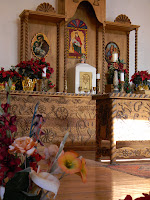
On Saturady (Feb 26) a 100-voice choir presented an “organized spontaneous” sing at the Las Cruces Museum of Art. The choir consisted of members from NMSU Choirs’ University Singers, Masterworks Chorus, Mesilla Valley Chorale, New Desert Harmony Singers, and Oñate High School Choir. Interspersed around the exhibit of Michael Naranjo sculptures, they slowly gathered together to perform. Here’s one of the selections ... City Called Heaven ... with Guo Ying as soloist.
Welcome to the Explore! New Mexico blog
Sunday, February 27, 2011
Museum of Art Features "Organized Spontaneous" Sing
Wednesday, February 16, 2011
Book Review: A Good Goodbye

While Explore! New Mexico focuses on the Land of Enchantment and while we travel the state, exploring the people, places, history, and culture of New Mexico, there is one journey we all make ... the journey at the end of life.
New Mexican author Gail Rubin has written a book certain to inform, enlighten, and guide every one of us on this final journal. She has taken on society’s last taboo, producing a readable and practical guidebook with a light touch.
Entitled A Good Goodbye, the book details funeral planning for those who don’t plan to die. Its dozen chapters outline aspects of funerals that create a meaningful memorial, avoid stress at a time of grief, incorporate funeral traditions for major faiths, utilize new trends, and more. The family has that much more comfort in saying goodbye and celebrating the decedent’s life, when many of the decisions are made well in advance of death.
Gail Rubin is an event planner specializing in funerals and memorial services. A breast cancer survivor, she is a member of the Association for Death Education and Counseling, the cemetery committee for Congregation Albert in Albuquerque, and a member of the Chevra Kaddisha, a volunteer organization that ritually prepares the bodies of Jews for burial. More information is available at www.agoodgoodbye.com.
Book Review: Seven Cities of Mud

As we have traveled New Mexico we have made friends with writers who live in and write about New Mexico. From time to time, we’ll offer you a review and our impressions of their stories. And we’ll encourage you to explore New Mexico through its many authors who bring their own images of our Land of Enchantment to life.
Seven Cities of Mud
By Florence B. Weinberg
Published 2008 by Twilight Times Books
ISBN: 1-933353-46-5
Strong-willed Franciscan Fray Augustin organizes an entrada from Mexico into New Mexico a half century after Coronado, intent of converting Native Americans to Christianity. He recruits two other friars and eight soldiers. The entourage, with servants and livestock, embarks on a journey that carries them as far north as Taos and into the complexities of reconciling European culture with that of the Puebloans. Meanwhile, Poli, a pueblo woman whose husband suspiciously falls to his death soon after their marriage, is confronted by the arrogant, powerful, and cruel Makta, whose only desire is to possess her. Needless to say, the soldiers are there for treasure and complicate the situation. Priests, warriors, and Puebloans are in conflict the moment they are joined. Weinburg weaves a fascinating tale, integrating the history of Spanish conquest in a satisfying, nonintrusive way. Not only did I read a marvelous tale, I learned a bit more about my adopted home state.
Seven Cities of Mud is one of a series of historical novels set in the American Southwest and was a 2008 finalist for the New Mexico Book Awards.
- Book review by Bud Russo
Thursday, February 10, 2011
Happy Green Chile Cheeseburger Trail To You!

Hey! It’s time to hit the Green Chile Cheeseburger Trail. If you’re a carnivorous gourmand, you just have to dive into this adventure and explore the trail with us.
When the Green Chile Cheeseburger Trail was opened in 2009, it had nearly 50 restaurants ... many with more than one location. What that meant was you could try a different burger at nearly 100 different dining venues. We’re told, about 8,000 residents, visitors, and restauranteurs checking out the competition weighed in. I suspect they weighed more on the way out, too!
New Mexicans ... like me ... sorry, but Cheryl’s a vegetarian ... just can’t get enough of a juicy, thick New Mexico beef patty grilled to perfection, then swathed in Cheddar or another favorite cheese, and topped with enough New Mexican green chile to set off the restaurant’s smoke alarm. Just the thought has me salivating so much, my keyboard thinks it’s been hit by a tsunami!
[Credit time: We took the map from the New Mexico Tourism Department's web site. Thanks for the loan.]
Ok. So here’s how the trail works. Restaurant owners can register their burger at the New Mexico Tourism Department web site. Then ... starting at 6 a.m. on March 1 ... think of it, green chile cheeseburgers for breakfast!!! ... you can sign in at the web site ... www.newmexico.org/greenchilecheeseburger ... and vote. Voting is open until 6 p.m. on March 31. But ... here’s the catch ... you can vote only once ... unless you have multiple email addresses. The rule says only one vote will be accepted from a specific email address.
So ... Chomp around until you find the green chile cheeseburger that reminds your taste buds of Anna Pavlova whose rendition of the dying swan in Swan Lake was so tender, it’d make you cry ... or Glen Campbell plunking your heart strings with one of his touching love songs ... or the Green Bay Packers winning the Super Bowl. Then vote.
There are no prizes. The chef of the best green chile cheeseburger gets nothing but the satisfaction of being King ... or Queen ... on the hill until the next time we wander down the trail.
I have my favorite and I’m voting for what I consider the best green chile cheeseburger in the country. Yeah, I know it’s only New Mexico, but they sure don’t know how to make’em anywhere else but here.
Good huntin’! Good eatin’! Compadres.
Posted by Bud Russo
Monday, January 31, 2011
Mile Markers Are Giving Me a Great Education!
Doña Ana Poised For Future as Tourist Destination
The wagons churned along the Rio Grande over El Camino Real, advancing only a dozen miles or so each day. Travelers stopped at camps or parajes between Mexico City and Santa Fe. Most of those camps are distant memories, lost in the shifting sands of the desert and the changing course of the river. One of the camps has persisted into the 21st century. We know it as the village of Doña Ana.
On January 15, State Senator Mary Jane Garcia hosted the grand opening of the De La O Visitors Center in Doña Ana, culminating many years’ work of the many descendants who claim the name De La O and creating a focal point for community activities and tourists.
During the festivities, Sen. Garcia asked a show of hands of those who have come from the original De La O family. The senator is cousin to many of the village’s residents. She pointed to one man and asked if he was De La O, to which he concurred. Said the senator, “I’ve known you 20 years and didn’t know you were De La O. Hello, cousin!”
Those attending the grand opening included Las Cruces Mayor Ken Miyagishima, several Las Cruces City Councillors,
representatives of Doña Ana County government, and other dignitaries. Unlike most other similar events, this one had the festive appeal of a family reunion.
Doña Ana dates to the late 17th century. The village, if if could have been called that at the time, was abandoned throughout most of the 18th century. According to Robert Julyan in his book, “The Place Names of New Mexico,” the governor of Chihuahua created the Doña Ana Bend Colony Grant to alleviate crowding in El Paso. But it was not settled until 1843 when Bernabé Montoya led thirty-three settlers to the site. They named their settlement after the semi-legendary Doña Ana, who may have been Ana Robledo who had fled south during the Pueblo Revolt, or Doña Ana María de Córdoba, whose ranch was nearby.
Whoever the name honored, settlers were determined to remain in their village, to farm and to thrive. El Camino Real ran through the heart of the village. It brought not only travelers and trade but also bandidos. It was also prey to
marauding bands of Apache. But it persisted.
Between 1845 and 1850, a decade before the village of Las Cruces was laid out, villagers built a church. It was about a hundred feet long and twenty feet wide. Its adobe walls were three feet thick and its windows high to prevent Indians and bandits from shooting at people sequestered there. Candles in chandeliers and sconces between the Stations of the Cross dimly lit the church. A single clerestory window above the nave close to the apse let in the early morning light to illuminate the altar during Mass.
During the Civil War, De La O opened a saloon about a hundred yards south of the church. Just north of the saloon, Werthheim opened a general store, and north of that was the residence of the Cavello family.
Those buildings have persisted into the present time, but barely. In the late 1970s, the church was about to be condemned and demolished. The adobe buildings down the street had faired better, perhaps because of their boxy single-story construction. The structures seemed destined to melt into history just as old adobe returns to the earth.
But the community, led by Sen. Garcia, had other plans. Over a decade, Doña Anans, including some at-risk youth, rebuilt the church. They made more than 17,000 adobe bricks to reconstruct one wall which had collapsed and to shore up other parts of the building. Using a design of local artist Jeannie De Lo O Carbajal, who designed the art adorning the I-25 underpass at Highway 320, artisans in Mexico built a new altar patterned on the original which had deteriorated too far to reclaim. They retained the church’s original vigas and corbels and conserved the original French paintings of the fourteen Stations of the Cross. The church today is used for special occasions, including baptisms and marriages.
Then restoration work shifted down Camino Real, which for nearly two decades has been called Cristo Rey, to the old saloon and adjacent buildings.
The L-shaped De La O saloon has been restored with two meeting rooms and the mirror-backed bar, just as it might have looked 150 years ago. Its adobe has been painted white and its walls hung with historical scenes of the village of two centuries ago. Behind the building is a brick placita with fountain, stone planters, and shade trees. The community now has a facility for activities, celebrations, and fiestas.
As funds permit, the Werthheim building will be restored as a mercantile museum and the Cavello house will become the site of a farmers’ market.
For those who think Camino Real is nothing more than two ruts in the desert, come to the village of Doña Ana and see what family can do.
If you’d like to see the restored historic buildings and walk along part of the original royal highway, take Exit 9 off I-25 and turn south on Thorpe Road (NM-320). At the modern Catholic church, Our Lady of Purification, turn left onto Dusty Lane, which bends around the church and becomes Cristo Ray Street.
Sunday, January 30, 2011
100 Best New Mexico Books
TOP TEN
"Bless Me, Ultima" - Rudolfo Anaya
"A Thief of Time" - Tony Hillerman
"Ben Hur" - Lew Wallace
"Death Comes for the Archbishop" - Willa Cather
"First Blood" - David Morrell
"House Made of Dawn" - N. Scott Momaday
"Lamy of Santa Fe" - Paul Horgan
"Milagro Beanfield War" - John Nichols
"Red Sky at Morning" - Richard Bradford
"The Rounders" - Max Evans
THE REST
"Alburquerque" - Rudolfo Anaya
"All the Pretty Horses" - Cormac McCarthy
"The Authentic Life of Billy the Kid" - Pat Garrett
"Black Mesa Poems" - Jimmy Santiago Baca
"Black Range Tales" - James A. McKenna
"The Blessing Way" - Tony Hillerman
"Blood and Thunder" - Hampton Sides
"Bloodville" - Don Bullis
"Bluefeather Fellini" - Max Evans
"Brothers of Light, Brothers of Blood" - Marta Weigle
"But Time and Chance" - Fray Angelico Chávez
"The Centuries of Santa Fe" - Paul Horgan
"Ceremony" - Leslie Marmon Silko
"Chaco Banyon: Sheriff of Lordsburg" - Fred Schmidt
"Chaco Canyon" - Robert Hill Lister
"Charlie Carrillio: Tradition & Soul" - Barbe Awalt and Paul Rhetts
"Coronado, Knight of Pueblos and Plains" - Eugene Bolton
"Cuentos" - Rudolfo Anaya
"Curse of the ChupaCabra" - Rudolfo Anaya
"Dance Hall of the Dead" - Tony Hillerman
"The Day It Snowed Tortillas" - Joe Hayes
"Delight Makers" - Aldolph Bandelier
"Ditch Rider" - Judith Van Gieson
"The Education of Little Tree" - Forrest Carter
"Eight Rattles and a Button" - Merle Blinn Brown
"El Gringo: New Mexico & Her People" - Josiah Gregg
"Face of an Angel" - Denise Chavez
"Fire on the Mountain" - Edward Abbey
"Forgotten People" - George I. Sánchez
"Great River" - Paul Horgan
"Hatchet" - Gary Paulsen
"Homesteading on Grasshopper Flats" - Etta Rose Knox
"The House at Otowi Bridge" - Peggy Pond Church
"I Fought with Geronimo" - Jason Betzinez & Wilbur Sturtevant
"An Illustrated History of New Mexico" - Thomas Chavez
"In the Days of Victorio" - Eve Ball
"Jemez Spring" - Rudolfo Anaya
"John Gaw Meem" - Bainbridge Bunting
"Journeys of Faith" - Lee Priestley
"Kiva, Cross, & Crown" - John Kessell
"History of La Mesilla & Her Mesilleros" - Lionel Cajen Frietze
"Land of Poco Tiempo" - Charles Lummis
"Las Cruces" - Linda G. Harris
"The Last Conquistador" - Marc Simmons
"The Leading Facts of New Mexican History" - Ralph Emerson Twitchell
"The Legend of La Llorona" - Rudolfo Anaya
"Lottie Deno" - J. Marvin Hunter
"Maria" - Alice Marriott
"Mayordomo" - Stanley Crawford
"Mimbres Painted Pottery" - J.J. Brody
"The Missions of New Mexico, 1776" - Fray Francisco Dominguez, edited by Adams & Chávez
"My Penitente Land" - Fray Angelico Chavez
"New Mexico: A Pageant of Three Peoples" - Erna Fergusson
"New Mexico Biographical Dictionary, 1540-2000" - Don Bullis
"New Mexico Style" - Nancy Hunter Warren
"New Mexico Tinwork" - Lane Coulter
"No Life for a Lady" - Agnes Morley Cleaveland
"Nobody's Horses" - Don Hoglund
"Origins of New Mexico Families" - Fray Angelico Chavez
"People of the Valley" - Frank Waters
"The Place Names of New Mexico" - Robert Julyan
"Popular Arts of Spanish New Mexico" - E. Boyd
"Pueblo Nations" - Joe Sando
"Riders to Cibola" - Norman Zollinger
"Rio Grande Fall" - Rudolfo Anaya
"River of Traps" - William duBoys & Alex Harris
"Roadside Geology of New Mexico" - Halka Chronic
"Sabino's Map" - Donald Usner "Saints of the Pueblos" - Charles M. Carrillo
"Santa Fe Design" - Elmo Baca
"Santa Fe on Foot" - Elaine Pinkerton Coleman
"Santa Fe Style" - Christine Mather "Santos & Saints" - Thomas J. Steele, S.J
"Scavengers" - Steven Havill
"Shaman Winter" - Rudolfo Anaya
"Slash Ranch Hounds" - Dub Evans
"Stolen Gods" - Jake Page
"Tularosa" - Michael McGarrity
"Villages of Hispanic New Mexico" - Nancy Hunter Warren
"Visions Underground" - Lois Manno
"When Jesus Came, the Corn Mothers Went Away" - Ramon Gutierrez
"The Whole Damned World" - Martha Shipman Andrews
"Wind Leaves No Shadow" - Ruth Laughlin
"Winter in Taos" - Mabel Dodge Luhan
"The Wolf Path" - Judith Van Gieson
"The Woman at Otowi Crossing" - Frank Waters
"Works on Paper" - Georgia O'Keeffe & Barbara Haskell "Zia Summer" - Rudolfo Anaya
"Zuni Pottery" - Marian Rodee