Welcome to the Explore! New Mexico blog

Explore! New Mexico searches the state for interesting stories to tell our listeners and readers - and now our blog followers! We are currently producing a series of multi-media podcasts for the Las Cruces Convention and Visitors Bureau about interesting events and places to visit. You can view them at our YouTube channel. Be sure to visit our website where you can get even more ideas about where to travel in the Land of Enchantment.
Showing posts with label museums. Show all posts

Monday, January 31, 2011

Doña Ana Poised For Future as Tourist Destination


The wagons churned along the Rio Grande over El Camino Real, advancing only a dozen miles or so each day. Travelers stopped at camps or parajes between Mexico City and Santa Fe. Most of those camps are distant memories, lost in the shifting sands of the desert and the changing course of the river. One of the camps has persisted into the 21st century. We know it as the village of Doña Ana.


On January 15, State Senator Mary Jane Garcia hosted the grand opening of the De La O Visitors Center in Doña Ana, culminating many years’ work of the many descendants who claim the name De La O and creating a focal point for community activities and tourists.


During the festivities, Sen. Garcia asked a show of hands of those who have come from the original De La O family. The senator is cousin to many of the village’s residents. She pointed to one man and asked if he was De La O, to which he concurred. Said the senator, “I’ve known you 20 years and didn’t know you were De La O. Hello, cousin!”


Those attending the grand opening included Las Cruces Mayor Ken Miyagishima, several Las Cruces City Councillors,

representatives of Doña Ana County government, and other dignitaries. Unlike most other similar events, this one had the festive appeal of a family reunion.


Doña Ana dates to the late 17th century. The village, if if could have been called that at the time, was abandoned throughout most of the 18th century. According to Robert Julyan in his book, “The Place Names of New Mexico,” the governor of Chihuahua created the Doña Ana Bend Colony Grant to alleviate crowding in El Paso. But it was not settled until 1843 when Bernabé Montoya led thirty-three settlers to the site. They named their settlement after the semi-legendary Doña Ana, who may have been Ana Robledo who had fled south during the Pueblo Revolt, or Doña Ana María de Córdoba, whose ranch was nearby.


Whoever the name honored, settlers were determined to remain in their village, to farm and to thrive. El Camino Real ran through the heart of the village. It brought not only travelers and trade but also bandidos. It was also prey to

marauding bands of Apache. But it persisted.


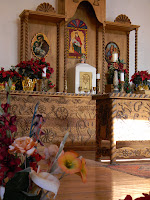
Between 1845 and 1850, a decade before the village of Las Cruces was laid out, villagers built a church. It was about a hundred feet long and twenty feet wide. Its adobe walls were three feet thick and its windows high to prevent Indians and bandits from shooting at people sequestered there. Candles in chandeliers and sconces between the Stations of the Cross dimly lit the church. A single clerestory window above the nave close to the apse let in the early morning light to illuminate the altar during Mass.


During the Civil War, De La O opened a saloon about a hundred yards south of the church. Just north of the saloon, Werthheim opened a general store, and north of that was the residence of the Cavello family.


Those buildings have persisted into the present time, but barely. In the late 1970s, the church was about to be condemned and demolished. The adobe buildings down the street had faired better, perhaps because of their boxy single-story construction. The structures seemed destined to melt into history just as old adobe returns to the earth.


But the community, led by Sen. Garcia, had other plans. Over a decade, Doña Anans, including some at-risk youth, rebuilt the church. They made more than 17,000 adobe bricks to reconstruct one wall which had collapsed and to shore up other parts of the building. Using a design of local artist Jeannie De Lo O Carbajal, who designed the art adorning the I-25 underpass at Highway 320, artisans in Mexico built a new altar patterned on the original which had deteriorated too far to reclaim. They retained the church’s original vigas and corbels and conserved the original French paintings of the fourteen Stations of the Cross. The church today is used for special occasions, including baptisms and marriages.


Then restoration work shifted down Camino Real, which for nearly two decades has been called Cristo Rey, to the old saloon and adjacent buildings.


The L-shaped De La O saloon has been restored with two meeting rooms and the mirror-backed bar, just as it might have looked 150 years ago. Its adobe has been painted white and its walls hung with historical scenes of the village of two centuries ago. Behind the building is a brick placita with fountain, stone planters, and shade trees. The community now has a facility for activities, celebrations, and fiestas.


As funds permit, the Werthheim building will be restored as a mercantile museum and the Cavello house will become the site of a farmers’ market.


For those who think Camino Real is nothing more than two ruts in the desert, come to the village of Doña Ana and see what family can do.


If you’d like to see the restored historic buildings and walk along part of the original royal highway, take Exit 9 off I-25 and turn south on Thorpe Road (NM-320). At the modern Catholic church, Our Lady of Purification, turn left onto Dusty Lane, which bends around the church and becomes Cristo Ray Street.


Tuesday, September 28, 2010

Klipsch Museum Chronicles the Life of an Acoustic Genius


Even with my hearing deficiency, I can tell the sound coming from speakers the size of small chests of drawers is exceptional. The separation of the music from left to right is so distinct, it’s as if two different tracks were playing. And resonance from bass to treble bubbles forth in a rich palette of color.


The speakers are Klipschorn and the place where I’m listening to them is the Paul W. and Valerie S. Klipsch Museum in NMSU’s College of Engineering, specifically the Foreman engineering complex just south of the venerable Goddard Hall.


The museum was dedicated in 1997, when the Foreman building was completed, and, although the museum is more than a dozen years old, its treasures are virtually unknown by Las Cruceans.


Paul Klipsch undoubtedly deserves the recognition for the masterpiece speakers he created. He’s in the Audio Hall of Fame and the Engineering and Science Hall of Fame. NMSU’s School of Electrical and Computer Engineering was named in his honor. Of greatest interest to me is the fact Klipsch is also an Aggie. He graduated in 1926 when the university was still New Mexico College of A&M. I received my degree in 1966.


And then there’s Joe Creed, who also earned his degrees from NMSU. He’s Assistant Dean of the College of Engineering and Professor Emeritus. Before he retired, Prof. Creed not only taught but, as dean, was responsible for alumni relations with the college. That’s how he met the Klipschs and got involved in the museum.


Following graduation, Klipsch worked as a geophysicist until the beginning of World War II. He enlisted in the Army at the rank of Major and was assigned to the Southwest Proving Grounds in Hope, Arkansas, where he specialized in ballistics, earning several patents for his work. When the war ended he remained in Hope. His lifelong love of music undoubtedly contributed to his interest in building speakers, which he began doing in a tin building behind a dry cleaner.


The business prospered, perhaps despite its founder. According to Prof. Creed, “Paul Klipsch was more interested in building the best and most beautiful speakers he could and not just making money.”


Because his wife, Valerie, was so much a part of his life and the business, I’d be remiss if I did not include this story. Mrs. Klipsch was born in Austria and immigrated to the United States prior to the war. Since Hope was their home, I had to venture an obvious question: Did they know the Clintons? Prof. Creed told me, Valerie Klipsch was an accomplished pianist and taught piano in Hope. “She was, in fact, Bill Clinton’s piano teacher,” he says, “but she recommended he take up saxophone because his hands were too large for piano.”


Klipsch continued to refine and build even better speakers. His Klipschorn speakers are considered the best sound producing instruments of their time. Built for installation in a corner, the speakers use the walls as part of the bass horn to reach the high fidelity they achieve, proving it was possible to reproduce the sound of a live orchestra in a home. Their name, however, was not chosen by their designer.


In an 1999 interview, Klipsch said he made a sales call to a prospect in New York and was surprised to learn the man already know about his speakers. “We’ve heard about your corner horn,” the prospect said. “We call it the Klipschorn.”

n time, the Klipschs decided to retire and sold the business to Fred Klipsch, Paul’s brother. The business exists today, based in Indianapolis. The plant in Hope is also still there and the unique Klipschorn speakers are still being built there, albeit as special order items.


Paul and Valerie Klipsch had always had high regard for NMSU. They endowed a scholarship fund that supports about 45 students annually. They also had a small museum in Hope and decided to donate it to the university.


Enter Joe Creed. “Taking care of alumni was just part of my job,” he says. “That’s when I met Paul and Valerie and got involved with the museum. I was lucky to be here when they came to make their donation.”


He flew to Hope to accept the artifacts and memorabilia, rented a truck, and drove back to Las Cruces with the treasures.


That meeting led to a lifelong friendship, which continues to this day. While Klipsch died in 2004 at age 98, Mrs. Klipsch still lives in Hope. “I’ve been happy to be associated with the Klipschs,” Prof. Creed says, “because they are such gracious people.” He talks with Mrs. Klipsch frequently and often travels there to examine the newest items she’s found, since she’s constantly on the lookout for her husband’s earliest speakers.


When the Foreman building was completed, it had two spacious foyers. Prof. Creed convinced the university to make minor adjustments to the design of one of the foyers and turn it into space for the museum. There visitors can examine the various styles of speakers that came from the Klipsch factory, including the large, corner Klipschorn with its matched fronts in fine wood. Several of the speaker sets are wired to CD players so visitors can insert their music and listen to it. There are technical exhibits including a cutaway of the Klipschorn, an exhibit of the awards and honors Klipsch earned, photos chronicling his life, and a cabinet of his papers. Prof. Creed also rescued the office of the acoustic genius and has reassembled it as if Paul Klipsch has just stepped out for lunch.


The museum is open Tuesdays and Thursdays from 1 to 3 p.m. or you can call 646-2913 for an appointment. Prof. Creed is more than willing to share the stories embraced by the museum to anyone who is interested.


We all listen to music, but until your favorite composition resounds from a Klipschorn speaker, you haven’t really heard it. It’s worth the time to hear the difference and learn about the man who made it possible.


Posted by Bud Russo