Welcome to the Explore! New Mexico blog

Explore! New Mexico searches the state for interesting stories to tell our listeners and readers - and now our blog followers! We are currently producing a series of multi-media podcasts for the Las Cruces Convention and Visitors Bureau about interesting events and places to visit. You can view them at our YouTube channel. Be sure to visit our website where you can get even more ideas about where to travel in the Land of Enchantment.
Showing posts with label Las Cruces. Show all posts

Tuesday, May 31, 2011

Navajo Code Talkers honored in Las Cruces

On Memorial Day 2011, three Navajo Code Talkers were present at a ceremony in their honor at Veterans Memorial Park in Las Cruces, New Mexico. The occasion was brought about by a donation by Danny Montoya, who purchased bricks for the Walk of Honor for each of the 29 original Navajo Code Talkers. While the only surviving member of the original 29, Chester Nez, was unable to attend due to health problems, the three Code Talkers who did attend - Keith Little, Frank Chee Willetto, and Bill Toledo - are all actively involved in the Navajo Code Talkers Association and Foundation.

If you don't know the story, the Code Talkers were recruited to be communications specialists during World War II. It was essential to be able to develop a code unbreakable by the Japanese and the Marines thought that the Navajo language could serve as the basis of that code. They went to the Navajo reservation and recruited 30 men to go through training. Only 29 were able to make it to training, and thus became the honored original 29 who worked out the code that turned names of common military equipment into Navajo words. Even if the Japanese had been able to translate the words, they would not know what they referred to as they were not literal translations. The code developed by the Navajo Code Talkers helped the United States prevail in World War II.

Only about 50 of the 200+ Code Talkers survive today. Many of them are actively involved in planning a museum that will be located in northern New Mexico to preserve the story of the Code Talkers and the Navajo language.

I'll post more information after I read the book that I purchased yesterday as a donation towards the museum. A slide show of photos from the ceremony will also be posted soon.

- Cheryl Fallstead

Thursday, March 17, 2011

Branigan Cultural Center Hosts Archaeology Day


Can you dig it? April 2 is Archaeology Day at the Branigan Cultural Center in Las Cruces. Kids of all ages can learn how to make arrowheads, grind corn, make a rope, weave fabric, coil a clay pot, create paint ... all the while learning about the importance of archaeology to unearthing the past. No charge for getting you hands dirty from 10 am to 2 pm. Archeology Day is sponsored by the Branigan, BLM, CARTA, City of Las Cruces, National Park Service, U.S. Forest Service, Mesilla Valley Weavers Guild, and NMSU. More info at www.las-cruces.org/museums or call (575) 541-2154.


Posted by Bud Russo

Thursday, February 10, 2011

Happy Green Chile Cheeseburger Trail To You!


Hey! It’s time to hit the Green Chile Cheeseburger Trail. If you’re a carnivorous gourmand, you just have to dive into this adventure and explore the trail with us.


When the Green Chile Cheeseburger Trail was opened in 2009, it had nearly 50 restaurants ... many with more than one location. What that meant was you could try a different burger at nearly 100 different dining venues. We’re told, about 8,000 residents, visitors, and restauranteurs checking out the competition weighed in. I suspect they weighed more on the way out, too!


New Mexicans ... like me ... sorry, but Cheryl’s a vegetarian ... just can’t get enough of a juicy, thick New Mexico beef patty grilled to perfection, then swathed in Cheddar or another favorite cheese, and topped with enough New Mexican green chile to set off the restaurant’s smoke alarm. Just the thought has me salivating so much, my keyboard thinks it’s been hit by a tsunami!


[Credit time: We took the map from the New Mexico Tourism Department's web site. Thanks for the loan.]


Ok. So here’s how the trail works. Restaurant owners can register their burger at the New Mexico Tourism Department web site. Then ... starting at 6 a.m. on March 1 ... think of it, green chile cheeseburgers for breakfast!!! ... you can sign in at the web site ... www.newmexico.org/greenchilecheeseburger ... and vote. Voting is open until 6 p.m. on March 31. But ... here’s the catch ... you can vote only once ... unless you have multiple email addresses. The rule says only one vote will be accepted from a specific email address.


So ... Chomp around until you find the green chile cheeseburger that reminds your taste buds of Anna Pavlova whose rendition of the dying swan in Swan Lake was so tender, it’d make you cry ... or Glen Campbell plunking your heart strings with one of his touching love songs ... or the Green Bay Packers winning the Super Bowl. Then vote.


There are no prizes. The chef of the best green chile cheeseburger gets nothing but the satisfaction of being King ... or Queen ... on the hill until the next time we wander down the trail.


I have my favorite and I’m voting for what I consider the best green chile cheeseburger in the country. Yeah, I know it’s only New Mexico, but they sure don’t know how to make’em anywhere else but here.


Good huntin’! Good eatin’! Compadres.


Posted by Bud Russo

Monday, January 31, 2011

Doña Ana Poised For Future as Tourist Destination


The wagons churned along the Rio Grande over El Camino Real, advancing only a dozen miles or so each day. Travelers stopped at camps or parajes between Mexico City and Santa Fe. Most of those camps are distant memories, lost in the shifting sands of the desert and the changing course of the river. One of the camps has persisted into the 21st century. We know it as the village of Doña Ana.


On January 15, State Senator Mary Jane Garcia hosted the grand opening of the De La O Visitors Center in Doña Ana, culminating many years’ work of the many descendants who claim the name De La O and creating a focal point for community activities and tourists.


During the festivities, Sen. Garcia asked a show of hands of those who have come from the original De La O family. The senator is cousin to many of the village’s residents. She pointed to one man and asked if he was De La O, to which he concurred. Said the senator, “I’ve known you 20 years and didn’t know you were De La O. Hello, cousin!”


Those attending the grand opening included Las Cruces Mayor Ken Miyagishima, several Las Cruces City Councillors,

representatives of Doña Ana County government, and other dignitaries. Unlike most other similar events, this one had the festive appeal of a family reunion.


Doña Ana dates to the late 17th century. The village, if if could have been called that at the time, was abandoned throughout most of the 18th century. According to Robert Julyan in his book, “The Place Names of New Mexico,” the governor of Chihuahua created the Doña Ana Bend Colony Grant to alleviate crowding in El Paso. But it was not settled until 1843 when Bernabé Montoya led thirty-three settlers to the site. They named their settlement after the semi-legendary Doña Ana, who may have been Ana Robledo who had fled south during the Pueblo Revolt, or Doña Ana María de Córdoba, whose ranch was nearby.


Whoever the name honored, settlers were determined to remain in their village, to farm and to thrive. El Camino Real ran through the heart of the village. It brought not only travelers and trade but also bandidos. It was also prey to

marauding bands of Apache. But it persisted.


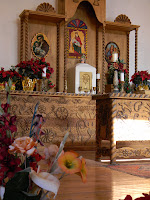
Between 1845 and 1850, a decade before the village of Las Cruces was laid out, villagers built a church. It was about a hundred feet long and twenty feet wide. Its adobe walls were three feet thick and its windows high to prevent Indians and bandits from shooting at people sequestered there. Candles in chandeliers and sconces between the Stations of the Cross dimly lit the church. A single clerestory window above the nave close to the apse let in the early morning light to illuminate the altar during Mass.


During the Civil War, De La O opened a saloon about a hundred yards south of the church. Just north of the saloon, Werthheim opened a general store, and north of that was the residence of the Cavello family.


Those buildings have persisted into the present time, but barely. In the late 1970s, the church was about to be condemned and demolished. The adobe buildings down the street had faired better, perhaps because of their boxy single-story construction. The structures seemed destined to melt into history just as old adobe returns to the earth.


But the community, led by Sen. Garcia, had other plans. Over a decade, Doña Anans, including some at-risk youth, rebuilt the church. They made more than 17,000 adobe bricks to reconstruct one wall which had collapsed and to shore up other parts of the building. Using a design of local artist Jeannie De Lo O Carbajal, who designed the art adorning the I-25 underpass at Highway 320, artisans in Mexico built a new altar patterned on the original which had deteriorated too far to reclaim. They retained the church’s original vigas and corbels and conserved the original French paintings of the fourteen Stations of the Cross. The church today is used for special occasions, including baptisms and marriages.


Then restoration work shifted down Camino Real, which for nearly two decades has been called Cristo Rey, to the old saloon and adjacent buildings.


The L-shaped De La O saloon has been restored with two meeting rooms and the mirror-backed bar, just as it might have looked 150 years ago. Its adobe has been painted white and its walls hung with historical scenes of the village of two centuries ago. Behind the building is a brick placita with fountain, stone planters, and shade trees. The community now has a facility for activities, celebrations, and fiestas.


As funds permit, the Werthheim building will be restored as a mercantile museum and the Cavello house will become the site of a farmers’ market.


For those who think Camino Real is nothing more than two ruts in the desert, come to the village of Doña Ana and see what family can do.


If you’d like to see the restored historic buildings and walk along part of the original royal highway, take Exit 9 off I-25 and turn south on Thorpe Road (NM-320). At the modern Catholic church, Our Lady of Purification, turn left onto Dusty Lane, which bends around the church and becomes Cristo Ray Street.


Tuesday, October 12, 2010

Spanish Brass Kicks Off Mesilla Valley Music Arts Program

Sitting at my computer this evening trying to decide wether to finish work or listen to the Spanish Brass. I chose the latter and I’m glad I did. Five men: tuba, trombone, French horn, and two musicians who played trumpet, flugelhorn, and piccolo horn, played music dating to 18th century and a composition finished three years ago. Trumpeter Carlos Grau said the most recent piece was done by a friend. After playing Caballeros Andantes, a complex and difficult piece, he said the composer wasn’t a friend any more. [Just joking].


They did dance numbers from Spain, Brazil, Mexico: a waltz, samba, and other Spanish rhythms. After intermission they turned to jazz, playing Lee Morgan’s The Sidewinder, Duke Ellington’s Caravan, and even a New Orleans rendition of Just A Closer Walk With Thee ... but at a much faster tempo than we usually hear at New Orleans funerals.


I happened to sit next to Allan Kaplan, principal trombone at the Las Cruces Symphony. He and I discussed the music ... actually he talked and I listened. He told me this quintette not only performs and rehearses together, they actually practice together ... running scales, practicing technique. In performance, it’s as if they are a single musical organism. Great communication between the players.


Light hearted and humorous, the earned the standing ovations from the SRO audience at the Sonoma Presbyterian Church. Crowd filled the assembly hall and most of the lobby.


Kudos to Barbara Toth, who recently founded Mesilla Valley Musical Arts to make sure Las Cruces continues to enjoy rich musical experiences. Check out the website: mvmusarts.org.


Posted by Bud Russo

Friday, August 13, 2010

Color Las Cruces Plein Air Festival Gets Underway Sep 3


Time to mark your calendar. Doña Ana Arts Council will kick off its first Color Las Cruces Plein Air Competition and Festival with an exhibit of work by the Plein Air Painters of El Paso. The exhibit will run the month of September and works will be on display at Rio Grande Theatre, El Paso Electric office on Water Street, and Carolene de Mesilla Galleries on the Downtown Mall next to the theatre. The exhibit kicks off at 5 p.m. on Sept 3 as part of the Downtown Art Ramble. The Festival is Sept 11 and 12 and features two Plein Air competitions, workshop, VIP artists' reception, and citywide gallery hop. In my untutored opinion, Plein Air is as close we can come to classical Impressionism without cloning Monet! The painting here is called Hollyhocks & Fountains and its by Candy Mayer.

Thursday, July 29, 2010

Wilderness -- Are Your For or Against?


The 1964 Wilderness Act defines wilderness as land having no human footprint. Well, actually that’s the only thing wilderness can have. But there is no tire track, no helicopter skid mark, no evidence of machinery at all.


The Organ Mountains-Desert Peaks Wilderness Act is completing its journey through the U.S. Senate and it seems likely to pass there as well as in the House. And yet, the legislation has remained controversial since its inception a few years ago.


At first glance, the Doña Ana lands to be set aside as wilderness don’t seem to quality. People have been living on and manipulating these lands for about 12,000 years -- ever since the first hunter-gatherers migrated into the area. Today much of the land is criss-crossed with dirt tracks. Some are actually graded county roads. Some are used by ranchers and others are abandoned mine roads. So what’s the point of wilderness designation for these lands?


Las Cruces is the second largest city in the state. When I first came here in 1961 as an NMSU student there were about 25,000 residents. Today that number is pushing toward 90,000 and beyond. We’ll know the exact number when the 2010 Census is complete.


People need homes, schools, businesses, and entertainment. Those structures need to be connected by roads, water and sewer systems, power lines, etc. All of that requires land. What once was rural ranching country is changing. How rapidly is a matter of conjecture. Spaceport America could bring substantial high-tech industry to Las Cruces. In fact, city leaders are hoping that’s the case. As the area becomes more urbanized, the old ways of living fade into the shadows. Most of us like a good steak, but we’re mostly detached from where our beef comes from -- other than the butcher at the grocery store. It may not be too many years before ranching in this area is simply economically unfeasible and the ranch land will be sold to developers.


Without some vision of land use, without protection, the more spectacular portions of land that define who we are could be lost. I’ve seen it happen in other places, most notably around Civil War battle sites back East where suburban subdivisions back up to the cramped portions of land that was once hallowed for the American blood spilt there.


Wilderness is the highest level of protection we can offer these lands, even though they may not be purely wild lands. They are, however, the most scenic and the most accessible to our community. And they need the protection to assure they will be there generations from now when we are nothing but our great grandchildren’s distant memories.


What’s your opinion? Should we support the Organ Mountains-Desert Peaks Wilderness Act? Why or why not?


Posted by Bud Russo

Monday, April 26, 2010

Must see places and events in Las Cruces, New Mexico

Explore! New Mexico is producing multi-media podcasts for the Las Cruces Convention and Visitors Bureau. So far, we've produced one on wine tasting along Highway 28 and another on the connection between the Bataan Death March and our area. Almost complete is a podcast on hiking in the Organ Mountains and in progress is one on local museums. We are beginning research on an overview of Las Cruces - history, people, places, things to do.

We want our series of podcasts to tell visitors about the best we have to offer. So, when you visit Las Cruces - or if you live here, when your friends and family visit - what are don't-miss activities? Is it all about the Whole Enchilada Festival? Wine festivals? Heading to the Fountain Theatre for films in an adobe theater? Or is Cruces your jumping-off place to go to White Sands Nat'l Monument? Let us know so that our podcasts can help visitors make the most of their trips!