Welcome to the Explore! New Mexico blog

Explore! New Mexico searches the state for interesting stories to tell our listeners and readers - and now our blog followers! We are currently producing a series of multi-media podcasts for the Las Cruces Convention and Visitors Bureau about interesting events and places to visit. You can view them at our YouTube channel. Be sure to visit our website where you can get even more ideas about where to travel in the Land of Enchantment.
Showing posts with label tourism. Show all posts

Friday, April 29, 2011

Lake Valley Clings To Its Colorful Past


If you’d visited Lake Valley in the 1850s, you would have seen mostly flat, grassy plains, low rounded hills, and the majestic Black Range ensconced on the horizon. You might have thought the valley serene, even idyllic.

Then in 1878, a rancher named McEvers or perhaps a prospector named Lufkin found silver ore. It was however low-grade, not much more than 40 ounces or 2-1/2 pounds of silver for every ton of rock dug. Remember, in those days, there were no electric or steam-driven mining machines. Dug meant pick and shovel, a hand-hammered drill, and maybe some dynamite, which had been invented in 1867.

In 1881, J. Whitaker Wright arrive in Lake Valley with George Daly, an Australian immigrant. The two men, along with George Roberts, formed the Sierra Grande Silver Mining Company. Their efforts to exploit the silver was frustrated because there appeared to be none but the low-grade ore.

Meanwhile, Apaches, led by Nana, decided the ranchers and miners had been in their homeland long enough and began raiding. They burned a rancher’s home and kidnapped his wife and children. George Daly led a group of miners in retaliation. His efforts cost him his life.

It was when they brought Daly’s body back to Lake Valley, the miners found the motherlode at a depth of 40 feet. I am reminded of a scene in Paint Your Wagon, where the vagabond miners are digging a grave for a compadre killed in a wagon accident, only to see gold glittering in the dirt. The response is hilarious if crude. And I wondered if Lake Valley silver was found that way when Daly’s grave was dug.

However, it worked out, miners excavated what became known as the Bridal Chamber and found a vein of silver so pure it was assayed at thousands of ounces per ton. One writer referred to the mine as having walls of pure silver. The Bridal Chamber gave up $2,775,000 in silver, becoming known as the richest silver mine ever found.

Of course, that’s when the trouble began. A rich strike brings more miners to town, sort of like vultures drawn to a corrupting carcass. The quiet town grew to have upwards of 4,000 residents, mostly men. So there were nearly two dozen saloons and a few bordellos. There were also “legitimate” businesses – general stores, hotels, drug store, barber shop, post office, livery, stage line, and assay office. There were also a church, school, and doctor in residence.

In a short time, miners had dug hundreds of shafts looking for more of the elusive silver. To keep cash flowing for mining operations, Wright and Roberts apparently salted areas or convinced naive investors the ore was richer than it was. These promotions made Wright a multimillionaire, while it made paupers out of many investors. By 1882, Robert’s fraudulent promotions threatened the company, and he sold out to Wright. Meanwhile, Wright’s questionable promotions led to a conviction of stock fraud in London in 1902, and he swallowed cyanide, committing suicide in the courtroom.

But I’m ahead of my story. In 1893, President Grover Cleveland changed the standard upon which paper money was based from silver to gold. Not only did silver prices plummet, the change also contributed to the Panic of 1893, a major economic depression that tipped the scales on many Lake Valley businesses. Silver mining was pretty much done by then.

Besides all the mining activities, ranching had remained a major industry in Lake Valley. Cattle in large numbers bring in rustlers in large numbers. Bob Alexander, in his book, Desert Desperadoes, recounts an episode of “door-bustin’ roundups at Lake Valley, Hillsboro, and Kingston.” The roundup was led by Major Albert Fountain and was intent on rooting out and destroying rustlers, led by John Kinney, whose Lake Valley ranch served as headquarters for the outlaws. The gunfights that followed were brutal. One newspaper reported alleged escaped prisoners were shot to pieces.

So went life in Lake Valley, a town in decline. One night in 1895, a man named Abernathy, a disgruntled and perhaps drunk customer of William Cotton’s saloon, set the bar on fire. Tinder dry wood and high winds fanned the flames, which consumed nearly all of Main Street, including the Keller, Miller & Company mercantile. Today, you know exactly where that store stood. Its safe sits in the dirt right where it was after the fire burned itself out.

Like all ghost towns, Lake Valley was never totally abandoned. Its life simply ebbed away every so slowly. Mrs. Blanch Nowlin, who became the local dealer for Conoco, lived in her house on Railroad Avenue until 1982. Pedro and Savina Martinez bought the Belle Hotel next door. He lived there until his death in 1994, having been a Lake Valley resident for 90 years.

During World War II, manganese was mined in the town, but that too was mined out and abandoned in the early 1950s.

I thought about this history as I walked the remains of the town. The Bureau of Land Management is responsible for Lake Valley [along with the still remaining Sierra Grande Mining Company]. The BLM restored the 1907 schoolhouse and turned it into a museum. Mrs. Nowlin’s Conoco store was the original school built in 1880. It’s awaiting a new roof and other restoration. I looked in at the chapel, where Episcopal services were held until the 1970s, and examined the remains of the Keil House and Dr. Beal’s House. The Nowlin and Martinez houses are privately owned and undergoing stabilization, efforts to prevent them from collapsing, so they might be opened to visitors.

Bob Denison, resident BLM manager, took me in his ATV to see the Bridal Chamber and other mines still on private property. I saw what’s left of the manganese ore processor. I saw head frames standing above a few of the 430 mine shafts dug throughout the area. One mine, the Last Chance, is home to bats and monitored by the state, watching for white-nose syndrome. Another, Denison told me, is the den of a mountain lion. None of them ever produced silver as rich as the Bridal Chamber, which has mostly collapsed as its timbers have aged.

Time is not kind to the remnants of our history and, unless someone values Lake Valley at lot more than it is now, it too will fade away, leaving behind decaying piles of lumber and melting mounds of ancient adobe. And that will be too bad because at Lake Valley, we can examine our colorful past and know better the roots from which we have grown.


Posted by Bud Russo


Monday, January 31, 2011

Mile Markers Are Giving Me a Great Education!

Can't tell you how much I'm learning! Having to research and write 260 Mile Marker radio features this year is quite a challenge, but it's turning into a fascinating education. There are so many interesting people who live ... and have lived ... in New Mexico ... so many stories, some funny, some tragic, some dramatically violent. I'm working on a story about a sheriff who got into a gunfight with drunk cowboys who would not relinquish their guns. The sheriff was killed. One cowboy was killed, two were wounded, the fourth escaped unharmed. One cowboy was gut shot so he couldn't run. The other two got away, but later were captured. All three were executed. The sheriff's deputy became sheriff. Now that was pretty normal for New Mexico in the 1800s. What sets this story apart is ... oops. If I tell you now, will I have to shoot you? Listen to our Mile Markers on KRWG in Las Cruces, KENW in Portales, or KSJE in Farmington ... or catch up on our New Mexico tales at our web site ... explorenewmexico.biz. We post all the Mile Marker stories the week after they've been broadcast. Have fun. I certainly am.

Bud Russo

Doña Ana Poised For Future as Tourist Destination


The wagons churned along the Rio Grande over El Camino Real, advancing only a dozen miles or so each day. Travelers stopped at camps or parajes between Mexico City and Santa Fe. Most of those camps are distant memories, lost in the shifting sands of the desert and the changing course of the river. One of the camps has persisted into the 21st century. We know it as the village of Doña Ana.


On January 15, State Senator Mary Jane Garcia hosted the grand opening of the De La O Visitors Center in Doña Ana, culminating many years’ work of the many descendants who claim the name De La O and creating a focal point for community activities and tourists.


During the festivities, Sen. Garcia asked a show of hands of those who have come from the original De La O family. The senator is cousin to many of the village’s residents. She pointed to one man and asked if he was De La O, to which he concurred. Said the senator, “I’ve known you 20 years and didn’t know you were De La O. Hello, cousin!”


Those attending the grand opening included Las Cruces Mayor Ken Miyagishima, several Las Cruces City Councillors,

representatives of Doña Ana County government, and other dignitaries. Unlike most other similar events, this one had the festive appeal of a family reunion.


Doña Ana dates to the late 17th century. The village, if if could have been called that at the time, was abandoned throughout most of the 18th century. According to Robert Julyan in his book, “The Place Names of New Mexico,” the governor of Chihuahua created the Doña Ana Bend Colony Grant to alleviate crowding in El Paso. But it was not settled until 1843 when Bernabé Montoya led thirty-three settlers to the site. They named their settlement after the semi-legendary Doña Ana, who may have been Ana Robledo who had fled south during the Pueblo Revolt, or Doña Ana María de Córdoba, whose ranch was nearby.


Whoever the name honored, settlers were determined to remain in their village, to farm and to thrive. El Camino Real ran through the heart of the village. It brought not only travelers and trade but also bandidos. It was also prey to

marauding bands of Apache. But it persisted.


Between 1845 and 1850, a decade before the village of Las Cruces was laid out, villagers built a church. It was about a hundred feet long and twenty feet wide. Its adobe walls were three feet thick and its windows high to prevent Indians and bandits from shooting at people sequestered there. Candles in chandeliers and sconces between the Stations of the Cross dimly lit the church. A single clerestory window above the nave close to the apse let in the early morning light to illuminate the altar during Mass.


During the Civil War, De La O opened a saloon about a hundred yards south of the church. Just north of the saloon, Werthheim opened a general store, and north of that was the residence of the Cavello family.


Those buildings have persisted into the present time, but barely. In the late 1970s, the church was about to be condemned and demolished. The adobe buildings down the street had faired better, perhaps because of their boxy single-story construction. The structures seemed destined to melt into history just as old adobe returns to the earth.


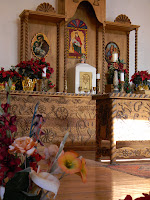
But the community, led by Sen. Garcia, had other plans. Over a decade, Doña Anans, including some at-risk youth, rebuilt the church. They made more than 17,000 adobe bricks to reconstruct one wall which had collapsed and to shore up other parts of the building. Using a design of local artist Jeannie De Lo O Carbajal, who designed the art adorning the I-25 underpass at Highway 320, artisans in Mexico built a new altar patterned on the original which had deteriorated too far to reclaim. They retained the church’s original vigas and corbels and conserved the original French paintings of the fourteen Stations of the Cross. The church today is used for special occasions, including baptisms and marriages.


Then restoration work shifted down Camino Real, which for nearly two decades has been called Cristo Rey, to the old saloon and adjacent buildings.


The L-shaped De La O saloon has been restored with two meeting rooms and the mirror-backed bar, just as it might have looked 150 years ago. Its adobe has been painted white and its walls hung with historical scenes of the village of two centuries ago. Behind the building is a brick placita with fountain, stone planters, and shade trees. The community now has a facility for activities, celebrations, and fiestas.


As funds permit, the Werthheim building will be restored as a mercantile museum and the Cavello house will become the site of a farmers’ market.


For those who think Camino Real is nothing more than two ruts in the desert, come to the village of Doña Ana and see what family can do.


If you’d like to see the restored historic buildings and walk along part of the original royal highway, take Exit 9 off I-25 and turn south on Thorpe Road (NM-320). At the modern Catholic church, Our Lady of Purification, turn left onto Dusty Lane, which bends around the church and becomes Cristo Ray Street.


Thursday, July 29, 2010

Wilderness -- Are Your For or Against?


The 1964 Wilderness Act defines wilderness as land having no human footprint. Well, actually that’s the only thing wilderness can have. But there is no tire track, no helicopter skid mark, no evidence of machinery at all.


The Organ Mountains-Desert Peaks Wilderness Act is completing its journey through the U.S. Senate and it seems likely to pass there as well as in the House. And yet, the legislation has remained controversial since its inception a few years ago.


At first glance, the Doña Ana lands to be set aside as wilderness don’t seem to quality. People have been living on and manipulating these lands for about 12,000 years -- ever since the first hunter-gatherers migrated into the area. Today much of the land is criss-crossed with dirt tracks. Some are actually graded county roads. Some are used by ranchers and others are abandoned mine roads. So what’s the point of wilderness designation for these lands?


Las Cruces is the second largest city in the state. When I first came here in 1961 as an NMSU student there were about 25,000 residents. Today that number is pushing toward 90,000 and beyond. We’ll know the exact number when the 2010 Census is complete.


People need homes, schools, businesses, and entertainment. Those structures need to be connected by roads, water and sewer systems, power lines, etc. All of that requires land. What once was rural ranching country is changing. How rapidly is a matter of conjecture. Spaceport America could bring substantial high-tech industry to Las Cruces. In fact, city leaders are hoping that’s the case. As the area becomes more urbanized, the old ways of living fade into the shadows. Most of us like a good steak, but we’re mostly detached from where our beef comes from -- other than the butcher at the grocery store. It may not be too many years before ranching in this area is simply economically unfeasible and the ranch land will be sold to developers.


Without some vision of land use, without protection, the more spectacular portions of land that define who we are could be lost. I’ve seen it happen in other places, most notably around Civil War battle sites back East where suburban subdivisions back up to the cramped portions of land that was once hallowed for the American blood spilt there.


Wilderness is the highest level of protection we can offer these lands, even though they may not be purely wild lands. They are, however, the most scenic and the most accessible to our community. And they need the protection to assure they will be there generations from now when we are nothing but our great grandchildren’s distant memories.


What’s your opinion? Should we support the Organ Mountains-Desert Peaks Wilderness Act? Why or why not?


Posted by Bud Russo

Pardon Billy The Kid?

The Las Cruces Sun-News reported July 29, Gov. Bill Richardson is initiating an inquiry into the alleged pardon of Billy the Kid by then Gov. Lew Wallace. If the facts merit it, the Governor is said to have decided, he would pardon the legendary outlaw.


The life of Billy the Kid is wrought with legends and myths, making it difficult now ... after more than 125 years ... to sift fact from fiction. The facts are these: Billy was tried in Mesilla, convicted and sentenced to hang for the murder of Sheriff William Brady in Lincoln. He escaped and was a fugitive for some months. He was shot and killed by Sheriff Pat Garrett, who had been tracking him all those months. Billy did indeed write Gov. Wallace asking for his intervention. The letters are on display at the New Mexico Museum of History in Santa Fe and the museum in the L.G. Murphy store in Lincoln.


The questions are these: Was Billy the lone shooter of Brady or, as some historians believe, was he only one of several of Alexander McSween’s Regulators to have shot the sheriff? Were the Regulators a vigilante committee bent on revenge over the murder of John Tunstall, Murphy’s rival, or duly sworn deputies of the law? Some believe Brady has at least nine bullet holes in him delivered by at least six guns. So, was Billy the killer or just the scapegoat? Was Billy looking for his girlfriend in Fort Sumner and was he armed with a six-gun and not a turkey leg the night Pat Garrett shot the fugitive? Did Garrett fire in self-defense or did he simply execute Billy? Convicted murderers at the time could be captured dead or alive and returned for execution of sentence.


The ultimate question, of course, is what purpose does it serve to pardon a man who’s been dead 129 years? Will it separate legend from fact? Will it benefit descendants of Billy the Kid ... assuming he sired any? Will it “settle the score”once for all?


Register your vote: Should the governor pardon Billy the Kid? Yes? Or No?


Oh, by the way, Pat Garrett’s death on February 29, 1908 ... a Leap Year ... is cloaked in as much mystery as his shooting of Billy. But that’s another story!


Posted by Bud Russo

Tuesday, July 13, 2010

Taos Daytrip: Kit Carson, Blumenschein & Bent

On our last day of travel, we headed along the High Road to Taos. Once there, we visited the Kit Carson Home and Museum as well as Carson's grave, stopped by the Gov. Bent house and gift shop, and toured the Blumenschein house and museum. In between we popped into any number of interesting galleries -- for which Taos is known.

Highway 68 runs from Espanola to Taos. That's how we came home. On our way there, we took thefamous High Road through Nambe, Truchas, and Penasco. The road wound and turned, often taking us back the way we came before heading northeast again. We rambled through juniper/pinon dotted hills with pine forest climbing higher up the mountains. Mt. Wheeler, the highest peak in NM, towered over us. It's a strikingly beautiful drive and, as we climbed higher into the pine forests, enjoyed grassy meadows dotted with wildflowers. At one point we hit the shoulder. We had just stopped to photograph a lovely church that two artists were painting and had barely started driving again when there to our right was a log flume. That's right! Two 20-foot-long logs had been hollowed out to move water to where we had no idea, but the technology was straight out of the 18th Century.

Cheryl had a particular interest in the Kit Carson house. Her great-grandmother lived across the street from the Carsons in Taosand the two families were friendly. Kit Carson's home eventually included 12 rooms in a few separate buildings. We toured four rooms of his home, which comprise the museum. Some rooms in another building are unstable and unsafe, soare not included in the museum. Another set of rooms across a courtyard are part of a gallery and gift shop. The museum is owned and operated by the Masons, as Carson was a member and they wanted to preserve his legacy. It was an interesting look into the character and life of the American hero. We went next to see the graves of Carson and his third wife, Josefa Jamarillo.


I had an interest the the Gov. Charles Bent house. In 1847, after Gen. Kearny left Santa Fe for California, many of the Indians and Mexicans in Taos -- those who resented the American take-over -- rose in revolt. They stormed the Bent house and murdered the governor. While he held them off, his wife and daughter, and Mrs. Carson pushed a hole in a back wall and escaped. Mrs. Bent is buried in the same cemetery as the Carsons. Charles Bent's grave is not there.

Ernest Blumenschein, an artist from back East, was enroute from Denver to Mexico
when his wagon broke. He rode on horseback into Taos to get repairs and fell in love with the town. He is one of the founders of the Taos Society of Artists, the foundation of today's art
s community. His house consists of nine rooms. They
were built at various times from 1797 to 1924. He and his wife purchased three rooms in 1919 and as other buildings came on the market, they acquired them and expanded their residence between 1924 and 1931. Blumenschein, his wife, Mary, and daughter, Helen, all were artists and much of their art is on display, along with some of their furnishings. The house is interesting to explore and the art compelling. However,
we felt the $8 entrance fee was a bit steep.

Tired from walking and the heat, we headed south, stopping at the St. Francis of Asis church in Rancho de Taos -- a popular subject of painters and photographers -- and then dropped from the high plateau into the Rio Grande gorge.

I had read about an adobe home in Rinconada having two Mississippi riverboat capstans decorating it and wondered if the house is still there. The story dated to 1928. While we didn't find the house, we did meet Mark Saxe, who runs a stone carving school and gallery. He said perhaps the 90-year-old man across the highway might know, but advised not visiting his property unannounced. We decided to wait and see if Mark could contact his neighbor and inform us of the whereabouts of the capstans.

We returned to Santa Fe exhausted from our week of travel. We've had an exciting journey, and will have many more stories to tell -- after we've had a few days rest. And of course, we can't wait to return to do more exploring!

Posted by Bud Russo

Monday, July 12, 2010

Visiting the Ancient Ones at Bandelier Nat'l Monument


I first visited Bandelier National Monument -- home of an ancient pueblo people -- in 1963. Not much has changed in 47 years. And why would it! The "ruins" are 800 years old. Kendrick Frazier, in his book on Chaco, said "ruins" was "our curiously inadequate work for the tangible remains of culture."

There is both a circular pueblo -- once 400 rooms in two to three stories -- and a series of long houses with both rooms carved into the tuff -- ash from an even more ancient volcano -- and stone rooms built in front of the cliff. As many as 500 people lived in Frijoles Canyon -- site of the pueblo near Los Alamos -- and not all areas were occupied at the same time. The canyon had people living there for perhaps two centuries.

We hiked the trail past the ruins -- climbing a hundred feet above the pueblo to the cliff dwellings. After 3/4 mile, we transitioned to the Alcove House trail another 1/2 mile farther into the canyon. The last 140 feet of this journey was straight up through a series of four ladders and narrow foot paths and stairs. There's only a kiva in the alcove and a great view of the canyon. The houses of the people who lived there are long gone.

The trail took us through Ponderosa pine with its heady scent, past yellow cone flowers, red penstemon, and purple beebaum, and over babbling Frijoles creek.

One highlight of the hike -- if not THE highlight -- was the three-foot-long diamondback rattlesnake we spotted creeping through the underbrush -- minding its own business.
Not only were we immersed in the history of the puebloans but also embraced by the natural beauty of the canyon.


Posted by Bud Russo

Sunday, July 11, 2010

Enjoying Northern NM: History, Art, Farmers Market

Today Bud and I visited four places, continuing our trend of filling our days with activity. Since we decided to return to the Folk Art Market on Sunday rather than today to face slightly smaller crowds, today we first stopped by the Santa Fe Farmers Market before heading north on I-25 to see Fort Union, Las Vegas and Pecos National Monument.


The Santa Fe Farmers Market reminds me of markets in California, but with a Southwestern flair. It is located at the Railyard, which is a thriving, upscale repurposed area. It has a large outdoor market supplemented by another indoor space. Shoppers can find a cornocopia of fresh produce, goat cheese, locally raised meats, flowers, freshly baked breads, garden plants, local honey, beeswax candles, and herbs. You can even leave with an official farmers market T-shirt, tote or apron. Musicians were livening the atmosphere and tucked into a corner of the indoor area, the local NPR station was broadcasting live. I bought some fresh goat feta cheese and Bud left with a pastry in hand, then we hit the road.

Bud is fascinated by old frontier forts and as Fort Union was the largest of the forts in New Mexico, we had to drive out to explore it. Once we arrived, I agreed that it was a fascinating place to visit. The skeletal ruins of the once-bustling fort now stand like silent sentinels over the grassy plains. As we walked the grounds, thunder rumbled in the distance, reminescent of the boom of cannon or the sharp cracks of rifle fire. But there is no longer a reason to fight here. The Comanche are gone and the Santa Fe Trail is reduced to ruts in the grass.

But you can stand at the edge of the trail, where thousands of hopeful 49ers once traveled on their way to California in search of gold. You can squint your eyes and imagine the wagons laden with only the most essential household goods and supplies, arriving with great relief at the safety of Fort Union. You can also imagine the soldiers and their families living out on these plains, far from any bustling city life, wondering what might happen next. One highlight may have been a trader's wagon train passing through on its way to Santa Fe, laden with merchandise from the East. The Santa Fe Trail was first a traders route, then used by the 49ers, and finally primarily a military route. All that is left to help your imagination are the remains of adobe walls, brick fireplaces and a few wagons. But it does still remain, providing a glimpse into the past of northern New Mexico.

From there, we made a brief stop in Las Vegas - the original Las Vegas as they like to say there, which this year is celebrating 175 years since its founding. We focused on the plaza, having read that it is the largest and nicest plaza in New Mexico. It is more like a central park, with green grass and tall trees with a gazebo in the center. While we were there, boys were skateboarding in it. The plaza is surrounded by a variety of galleries, shops and the cornerstone, the Plaza Hotel. We wandered about and greatly enjoyed the lovely shop the adjoins the hotel, which was hosting a Second Saturday wine tasting while we were there. Then we went into the lobby, which is certainly characteristic of the Victorian era from which the hotel dates. We even took a peek into some guest rooms, finding them comfortable and somewhat like a guest room at your grandmother's house where she keeps some of her nice antiques. One of the rooms we saw even had a mini-fridge and a microwave.

The town is working hard to revitalize this area. I found it charming and was fascinated by the historic plaques mounted on the walls of many of the buildings that indicated its original purpose and when it was built. One we saw had a link to some dark dealings: two members of the James Gang, Robert Ford and Dick Liddell, opened a saloon here after Liddell was pardoned for shooting Jesse James in the back.

From there, we headed to Pecos National Monument as Bud wanted me to see the ruins of the Pecos Pueblo. I wanted to climb down into the reproduction of a kiva. I had seen many beautiful pictures other photographers had taken from inside the kiva and had to try my hand at it. We wandered the trail, visiting only the areas with excavated ruins as we arrived close to the time that the park would be closing. The ruins of a church is the largest building on the grounds and it was the second and smaller of the churches built in this spot, the first having been destroyed during the 1680 Pueblo Revolt. The second church was completed in the next century.

All the locations we visited today gave us the opportunity to learn more about the people, places, history and culture of New Mexico, from the early Pueblo Indians and the Spaniards who came to convert them to the American army who was much later charged with keeping peace on the prairie. We saw how people, past and present, strive to build a sense of community, whether it be with art on a historic plaza or with fresh produce near an old railyard.

Posted by Cheryl Fallstead

Explore! New Mexico

Santa Fe International Folk Art Market 2010

Each July for eight years, the Santa Fe International Folk Art Market has attracted both artists and art buyers from the world around. I visited the first time in 2009 and returned in 2010, eager to not only meet new artists, but to find those with whom I had forged a connection the previous year. Bud and I attended the Friday night pre-market party, which allowed us the luxury of working our way through the boothes without the crowds that will be present Saturday and Sunday. I found both my friends from Kyrgyzstan, Erkebu Djumagulova and her daughter, and from Niger, Elhadji Koumama - a texile artist and a silversmith respectively. I had interviewed both of them last year and chatted with them both again this year, taking new photographs to remember them by.

We moved through the canopied areas, eager to visit as many boothes as we could before the party ended at 9 p.m. And of course, even though my goal was to get photos and stories, I couldn't help but find items I'd like to purchase.

I ran into another acquaintance who works with artists in Mexico helping them sell their work in the United States. This weekend he was assisting Oaxacan artist Jacobo Angeles Ojeda and his son. They create carved wooden animals that are unlike any I have seen. Their booth displayed not only their art, but that of others from the village. The price difference was commensurate with the difference in quality. Just before we arrived, they had sold a lion for $4400. A striking owl was sold as we were there. He had otters, cats, horned lizards, and an amazing stingray.

Bud visited with the artist's son, Ricardo Angeles, who demonstrated one of the important differences with their animals. They create all their own paints from natural sources. He showed Bud how he mixes indigo with lemon juice and honey to create a bright blue paint and how a tree bark mixed with juice and honey makes their red paint. The difference in their paints, along with their attention to detail and realistic depictions of the animals brings their work to an entirely new level from what we've come to expect.

While I would love to have purchased one of the otters for over $300 (and which represents about a month of labor), I ended up leaving with a small fish that a family member had made. A momento, but not the same as one of his exquisite and intricately painted sculptures. Perhaps when we return Sunday afternoon one will still be there and I'll let temptation win.

Another booth represented a women's cooperative from India, the SEWA Trade Faciliation Center. They told us a few amazing stories - one about misadventures in travel and another about their cooperative itself, which represents 1.3 million women. One of the artists, Jamuben, was traveling from India to Santa Fe alone and somehow ended up on the wrong plane and the wrong state. After a harrowing ordeal, compounded by her inability to speak English, she ended up in Santa Fe in time for the market. Her friends told us that after a good cry, Jamuben was able to bounce back and she seemed to be in good spirits. When I was looking at a small fabric purse and admiring the embroidery, Jamuben gestured to the embroidery and herself so I would know that it was her work. So, of course, I had to buy it. And at $12, it was quite a bargain!

It's nice to know when you're buying at the market that 90 percent of your purchase price goes home with the artists. On average, each artist earns $15,000 that helps supports a family, a village, a cooperative. According to the organization which runs the market, this year artists cooperatives in 44 boothes will represent 30,000 members and impact some 300,000 lives. First time artists can apply for funds to help pay for them to attend the market. The entire project is an amazing effort to allow artists from countries as big as China and as small as Rwanda to earn a living at their craft. It also allows us to visit the world without leaving Santa Fe as 51 nations are represented this year.

The market is held on Museum Hill near the Museum of International Folk Art. Wear your comfortable walking shoes and be prepared for crowds. But in addition, be ready to make friends with people from the world around and support them by buying their art. Learn more at www.folkartmarket.org.

Posted by Cheryl Fallstead

Explore! New Mexico

Friday, July 9, 2010

Spanish Colonial Village: El Rancho de Las Golondrinas

We headed out to El Rancho de Las Golondrinas Thursday not really knowing what to expect. Now I've been to Sturbridge Village in Massachusetts, where they've relocated a group of New England colonial houses to give you a sense of time and place. I've been to Mystic Seaport to experience whaling in the 1800s. One of my favorite East Coast places is Colonial Williamsburg and its sister living museums at Jamestown Settlement and a working Colonial farm at Yorktown. All of these span the early 1700s to the formation of the United States in 1787.

Las Golondrinas ... actually the ranch of the swallows ... is a living museum telling about Spanish colonial history. I came to think of it as the Williamsburg of the West.

We ventured into the first grouping of buildings. About 80 per cent of these have been standing since they were built in 1710. Others were added in the early 1800s after the fear of attack by Commanches passed. Over time the houses fell into other uses; e.g. a residence was used as a hay barn. In 1946, relatives of the family that had purchased the property decided to restore it as a Spanish colonial village. To the existing buildings, they added scores of others: a mill, schoolhouse, farm houses and working buildings. Each was found in northern New Mexico, and moved to Las Golondrinas. It is one place in New Mexico where you can observe and study life as it was in the 18th Century.

Docents, all of whom are volunteers, dress in period costumes and each told us a part of the story as we entered one building after another. I was really impressed with how knowledgeable they were. They've obviously studied hard. They were as excited to tell their stories as we were to listen. And they accommodated the "typical tourist" too. As our time ran short and we approached closing time, we found one man locking up houses. Cheryl said ... in jest ... tell us your story in 30 seconds. He stopped making his rounds, took us into a farmer's cottege and spent about 20 minutes telling us about how life was in the village where we were. That was certainly going beyond the call of duty.

While we were there on a weekday, the ranch hosts festivals over many weekends -- a spring and fall festival, wine festival, and Viva Mexico, a cooperative festival with the Mexican consulate. In fact, Viva Mexico is July 17 and 18.

This is a great place to immerse youself in colonial history -- and an even greater place for the kids to experience history. Check their web site: http://www.golondrinas.org/.

Posted by Bud Russo

Thursday, July 8, 2010

Chimayo Weaver's Tale

Chimayo may be best known today for it Sanctuario, but settlers in the early 1700s raised sheep, spun woolen yarn and wove fabrics. The village since has been known for its fiber artists.

We stopped at Trujillo's Weaving Shop and met Carlos who told us he is the 7th generation of weavers in his family. His son who has just begun working in the shop is the 8th.

We watched family members work on three looms. One woman operated the pedals alternating warp threads like a dancer. One old loom, Carlos told us, was his grandfather's and is now a century old.

While other weavers may use a blend of cotton and wool, the Trujillos use only wool for both warp and weft. They use commercially spun and dyed yarn but, Carlos said, the family used to do these tasks too when it kept sheep -- but it's too time consuming today.

It's somehow comforting to know the ancient skills are still very much alive and still bringing us wonderful woven works of art.

Posted by Bud Russo

Visit To San Ildefonso Pueblo

We're at San Ildefonso Pueblo at 9:30 in the morning. It's early and still. No one'sa about. Before we left, we learned many of the women had been rehearsing late the evening before for a ceremonial dance and probably had slept in.

When we think "pueblo," many of us picture Taos with its three and four stories of adobe buildings accessed by ladders. Here there are groupings of modest adobe houses, many of which have wooden sheds with metal roofs. Around the plaza are larger adobe homes -- connected like townhouses. Instead of ladders to the second story, there's a broad staircase. In the plaza there's a large ceremonial kiva. It too has a stairway leading to the roof. Entry into the kiva is by ladder from the roof.

The pueblo sits on a rise of land less than a mile from the Rio Grande. Photos from 1889 show no trees, so the thick bosque of cottonwoods along the river is only a century old -- pretty old for any of us -- and the trees are lofty and wide. Cheryl thought she heard the river babbling but it was only the wind in the dancing leaves of the cottonwood.

The pueblo's church is a replica of the original built in 1620 and destroyed during the Pueblo Revolt 40 years later. The ruin was demolished by a 1910 earthquake. The present church was completed in 1968.

We stopped by the government building where there's a museum featuring the black-on- pottery Maria Martinez made famous. We alswo visited several of the artists in their pottery shops. I was particularly lured toward Adelphia Martinez's shop both by the "Open" sign and the fragrance of bacon her daughter was cooking for the grandkids. Almost everyone we met was gracious and welcoming. But they must sometimes chaff at being the focus of tourists who may not realize this is their home and not some exhibit in a museum.

We met a couple from Japan making a three-week tour of the Southwest. After telling us where they'd been and where they're going, Cheryl mused they'd been more places she has.

Perhaps the highlight of the tour was our visit to the Cottonwood Trading Post, which was a gallery showing pottery, jewelry, paintings, and fiber art of Puebloans, though concentrating on those from San Ildefonso. The artwork is exquisite and I wanted one of each for my home. Too bad for my it's far beyond my budget.

We thought we'd spend maybe an hour but lingered and absorbed the culture of San Ildefonso for three hours.

Posted by Bud Russo

Wednesday, July 7, 2010

Beautiful, Stormy New Mexico Skies

On our way north today, the sky treated us to one of New Mexico's finest attributes. We watched the clouds form tall columns and spread into whispy anvils at altitude. We first noticed them over the San Mateo Mountains near Socorro and then east over the Manzano Mountains. Cloud formations were quite beautiful all the way to Santa Fe. Best of all was the light. Dark clouds formed backdrops to mountains bathed in soft light. The juniper dotted hills seemed to glow with a life of their own. There were showers all around us but far enough away that we didn't get to drive through one. I've traveled across this country, across Europe, and Oceania. I have marveled at the natural beauty everywhere I've been, but I can truthfully say I have never seen skies like I see here in my adopted home.

So much for the poetry. Weather forcast tomorrow, heavy rain and flooding.

Posted by Bud Russo
Explore! New Mexico

We've arrived in Santa Fe!

We've arrived in Santa Fe and are settled into our condo. Tomorrow we'll begin exploring in earnest, by heading out to see several pueblos near Espanola, the chapel at Chimayo, and Abiquiu. Bud wants to go to Rinconada because he read that an adobe house there - 80 years ago - was adorned with two capstans from Mississippi river boats. If we find them, we'll take a picture and then tell you how Mississippi river boats ended up in northern New Mexico!

At Nambe Pueblo, we hope to see a cascading waterfall. At San Ildefonso, the home of famed potter Maria Martinez, we'll tour the pueblo and see the museum that displays the pottery of Martinez and others. Ohkay Owingeh was the home of Popay, who led the 1680 Pueblo Revolt, and today they have a herd of buffalo at the bison park. But truly, what we want to get a feel for is the uniqueness of each pueblo, the people and the artisans who call them home. We'll be able to tell you more after we've spent time at each tomorrow.

Abiquiu promises a museum of anthropology as well as a museum of paleontology and the Ghost Ranch Piedra Lumbre Education and Visitor Center. South of Abiquiu is the Pashouinge Ruins with vistas of the Chama River Valley.

So, a full day is planned for tomorrow! We'll keep you posted each day on our travels, so keep checking back.

Posted by Cheryl Fallstead
Explore! New Mexico