Welcome to the Explore! New Mexico blog

Explore! New Mexico searches the state for interesting stories to tell our listeners and readers - and now our blog followers! We are currently producing a series of multi-media podcasts for the Las Cruces Convention and Visitors Bureau about interesting events and places to visit. You can view them at our YouTube channel. Be sure to visit our website where you can get even more ideas about where to travel in the Land of Enchantment.

Monday, January 31, 2011

Doña Ana Poised For Future as Tourist Destination


The wagons churned along the Rio Grande over El Camino Real, advancing only a dozen miles or so each day. Travelers stopped at camps or parajes between Mexico City and Santa Fe. Most of those camps are distant memories, lost in the shifting sands of the desert and the changing course of the river. One of the camps has persisted into the 21st century. We know it as the village of Doña Ana.


On January 15, State Senator Mary Jane Garcia hosted the grand opening of the De La O Visitors Center in Doña Ana, culminating many years’ work of the many descendants who claim the name De La O and creating a focal point for community activities and tourists.


During the festivities, Sen. Garcia asked a show of hands of those who have come from the original De La O family. The senator is cousin to many of the village’s residents. She pointed to one man and asked if he was De La O, to which he concurred. Said the senator, “I’ve known you 20 years and didn’t know you were De La O. Hello, cousin!”


Those attending the grand opening included Las Cruces Mayor Ken Miyagishima, several Las Cruces City Councillors,

representatives of Doña Ana County government, and other dignitaries. Unlike most other similar events, this one had the festive appeal of a family reunion.


Doña Ana dates to the late 17th century. The village, if if could have been called that at the time, was abandoned throughout most of the 18th century. According to Robert Julyan in his book, “The Place Names of New Mexico,” the governor of Chihuahua created the Doña Ana Bend Colony Grant to alleviate crowding in El Paso. But it was not settled until 1843 when Bernabé Montoya led thirty-three settlers to the site. They named their settlement after the semi-legendary Doña Ana, who may have been Ana Robledo who had fled south during the Pueblo Revolt, or Doña Ana María de Córdoba, whose ranch was nearby.


Whoever the name honored, settlers were determined to remain in their village, to farm and to thrive. El Camino Real ran through the heart of the village. It brought not only travelers and trade but also bandidos. It was also prey to

marauding bands of Apache. But it persisted.


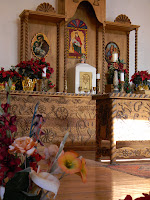
Between 1845 and 1850, a decade before the village of Las Cruces was laid out, villagers built a church. It was about a hundred feet long and twenty feet wide. Its adobe walls were three feet thick and its windows high to prevent Indians and bandits from shooting at people sequestered there. Candles in chandeliers and sconces between the Stations of the Cross dimly lit the church. A single clerestory window above the nave close to the apse let in the early morning light to illuminate the altar during Mass.


During the Civil War, De La O opened a saloon about a hundred yards south of the church. Just north of the saloon, Werthheim opened a general store, and north of that was the residence of the Cavello family.


Those buildings have persisted into the present time, but barely. In the late 1970s, the church was about to be condemned and demolished. The adobe buildings down the street had faired better, perhaps because of their boxy single-story construction. The structures seemed destined to melt into history just as old adobe returns to the earth.


But the community, led by Sen. Garcia, had other plans. Over a decade, Doña Anans, including some at-risk youth, rebuilt the church. They made more than 17,000 adobe bricks to reconstruct one wall which had collapsed and to shore up other parts of the building. Using a design of local artist Jeannie De Lo O Carbajal, who designed the art adorning the I-25 underpass at Highway 320, artisans in Mexico built a new altar patterned on the original which had deteriorated too far to reclaim. They retained the church’s original vigas and corbels and conserved the original French paintings of the fourteen Stations of the Cross. The church today is used for special occasions, including baptisms and marriages.


Then restoration work shifted down Camino Real, which for nearly two decades has been called Cristo Rey, to the old saloon and adjacent buildings.


The L-shaped De La O saloon has been restored with two meeting rooms and the mirror-backed bar, just as it might have looked 150 years ago. Its adobe has been painted white and its walls hung with historical scenes of the village of two centuries ago. Behind the building is a brick placita with fountain, stone planters, and shade trees. The community now has a facility for activities, celebrations, and fiestas.


As funds permit, the Werthheim building will be restored as a mercantile museum and the Cavello house will become the site of a farmers’ market.


For those who think Camino Real is nothing more than two ruts in the desert, come to the village of Doña Ana and see what family can do.


If you’d like to see the restored historic buildings and walk along part of the original royal highway, take Exit 9 off I-25 and turn south on Thorpe Road (NM-320). At the modern Catholic church, Our Lady of Purification, turn left onto Dusty Lane, which bends around the church and becomes Cristo Ray Street.


Sunday, January 30, 2011

100 Best New Mexico Books

The list of the 100 best New Mexico books was announced last week in anticipation of the State of New Mexico Centennial in 2012. I was surprised to see that I had only read seven of the books and also surprised that books I had enjoyed ages ago had a New Mexico connection.

Some are on my bookshelf awaiting quiet time to enjoy them. I noted that I have met four of the authors: the late, great Tony Hillerman (I am honored to have briefly met him and equally honored to now be able to call his daughter Anne a friend), Michael McGarrity (who I enjoyed interviewing for a radio show), and fellow Mesilla Valley residents Linda Harris and Denise Chavez. Another connection is that my husband, Brian, is a relative of General Lew Wallace, author of Ben Hur and one-time NM governor. Surprisingly, his book is not one that I have read, but of course I've seen the movie! We recently donated some books from Wallace's personal library to the New Mexico History Museum.

Perusing the list has encouraged me to make it a goal to read all 100 of them. Notice that I haven't given myself a time limit! I've put the books I've read in italics so you can see where I'm starting. Bud will also be reading some of them - he has read some I have not and vice versa. I'm not sure he's on board with going for all 100! Then we'll share our thoughts about them from time to time. Please feel free to share your reactions to those you've read - and other New Mexico books you enjoy!

- Posted by Cheryl Fallstead

100 BEST BOOKS IN NEW MEXICO

TOP TEN

"Bless Me, Ultima" - Rudolfo Anaya

"A Thief of Time" - Tony Hillerman

"Ben Hur" - Lew Wallace

"Death Comes for the Archbishop" - Willa Cather

"First Blood" - David Morrell

"House Made of Dawn" - N. Scott Momaday

"Lamy of Santa Fe" - Paul Horgan

"Milagro Beanfield War" - John Nichols

"Red Sky at Morning" - Richard Bradford

"The Rounders" - Max Evans

THE REST

"Alburquerque" - Rudolfo Anaya

"All the Pretty Horses" - Cormac McCarthy

"The Authentic Life of Billy the Kid" - Pat Garrett

"Black Mesa Poems" - Jimmy Santiago Baca

"Black Range Tales" - James A. McKenna

"The Blessing Way" - Tony Hillerman

"Blood and Thunder" - Hampton Sides

"Bloodville" - Don Bullis

"Bluefeather Fellini" - Max Evans

"Brothers of Light, Brothers of Blood" - Marta Weigle

"But Time and Chance" - Fray Angelico Chávez

"The Centuries of Santa Fe" - Paul Horgan

"Ceremony" - Leslie Marmon Silko

"Chaco Banyon: Sheriff of Lordsburg" - Fred Schmidt

"Chaco Canyon" - Robert Hill Lister

"Charlie Carrillio: Tradition & Soul" - Barbe Awalt and Paul Rhetts

"Coronado, Knight of Pueblos and Plains" - Eugene Bolton

"Cuentos" - Rudolfo Anaya

"Curse of the ChupaCabra" - Rudolfo Anaya

"Dance Hall of the Dead" - Tony Hillerman

"The Day It Snowed Tortillas" - Joe Hayes

"Delight Makers" - Aldolph Bandelier

"Ditch Rider" - Judith Van Gieson

"The Education of Little Tree" - Forrest Carter

"Eight Rattles and a Button" - Merle Blinn Brown

"El Gringo: New Mexico & Her People" - Josiah Gregg

"Face of an Angel" - Denise Chavez

"Fire on the Mountain" - Edward Abbey

"Forgotten People" - George I. Sánchez

"Great River" - Paul Horgan

"Hatchet" - Gary Paulsen

"Homesteading on Grasshopper Flats" - Etta Rose Knox

"The House at Otowi Bridge" - Peggy Pond Church

"I Fought with Geronimo" - Jason Betzinez & Wilbur Sturtevant

"An Illustrated History of New Mexico" - Thomas Chavez

"In the Days of Victorio" - Eve Ball

"Jemez Spring" - Rudolfo Anaya

"John Gaw Meem" - Bainbridge Bunting

"Journeys of Faith" - Lee Priestley

"Kiva, Cross, & Crown" - John Kessell

"History of La Mesilla & Her Mesilleros" - Lionel Cajen Frietze

"Land of Poco Tiempo" - Charles Lummis

"Las Cruces" - Linda G. Harris

"The Last Conquistador" - Marc Simmons

"The Leading Facts of New Mexican History" - Ralph Emerson Twitchell

"The Legend of La Llorona" - Rudolfo Anaya

"Lottie Deno" - J. Marvin Hunter

"Maria" - Alice Marriott

"Mayordomo" - Stanley Crawford

"Mimbres Painted Pottery" - J.J. Brody

"The Missions of New Mexico, 1776" - Fray Francisco Dominguez, edited by Adams & Chávez

"My Penitente Land" - Fray Angelico Chavez

"New Mexico: A Pageant of Three Peoples" - Erna Fergusson

"New Mexico Biographical Dictionary, 1540-2000" - Don Bullis

"New Mexico Style" - Nancy Hunter Warren

"New Mexico Tinwork" - Lane Coulter

"No Life for a Lady" - Agnes Morley Cleaveland

"Nobody's Horses" - Don Hoglund

"Origins of New Mexico Families" - Fray Angelico Chavez

"People of the Valley" - Frank Waters

"The Place Names of New Mexico" - Robert Julyan

"Popular Arts of Spanish New Mexico" - E. Boyd

"Pueblo Nations" - Joe Sando

"Riders to Cibola" - Norman Zollinger

"Rio Grande Fall" - Rudolfo Anaya

"River of Traps" - William duBoys & Alex Harris

"Roadside Geology of New Mexico" - Halka Chronic

"Sabino's Map" - Donald Usner "Saints of the Pueblos" - Charles M. Carrillo

"Santa Fe Design" - Elmo Baca

"Santa Fe on Foot" - Elaine Pinkerton Coleman

"Santa Fe Style" - Christine Mather "Santos & Saints" - Thomas J. Steele, S.J

"Scavengers" - Steven Havill

"Shaman Winter" - Rudolfo Anaya

"Slash Ranch Hounds" - Dub Evans

"Stolen Gods" - Jake Page

"Tularosa" - Michael McGarrity

"Villages of Hispanic New Mexico" - Nancy Hunter Warren

"Visions Underground" - Lois Manno

"When Jesus Came, the Corn Mothers Went Away" - Ramon Gutierrez

"The Whole Damned World" - Martha Shipman Andrews

"Wind Leaves No Shadow" - Ruth Laughlin

"Winter in Taos" - Mabel Dodge Luhan

"The Wolf Path" - Judith Van Gieson

"The Woman at Otowi Crossing" - Frank Waters

"Works on Paper" - Georgia O'Keeffe & Barbara Haskell "Zia Summer" - Rudolfo Anaya

"Zuni Pottery" - Marian Rodee

Monday, January 24, 2011

Want to be on TV? Go to Sparky's!

Perhaps the phrase “If you build it, they will come” applies to restaurants as well as baseball fields. Josie and Teako Nunn have spent the last three years building their business, Sparky’s Burgers, Barbecue, and Espresso, in Hatch, New Mexico. The delicious food and fun atmosphere have brought it to the attention of a number of media outlets. It was recently mentioned in Sunset magazine with a larger article coming this fall, and featured in segments on KRWG-TV Newsmakers, Explore! New Mexico’s radio show, and Spicy RV, along with rave reviews in newspapers and on lots of travel and food websites.


Recently, they were contacted by the producers of an upcoming Discovery Channel show, “Road Eats.” A film crew will descend upon the funky eatery on Wednesday, February 2, from 9 a.m. until 4 p.m. to film the staff and diners. This is a day the restaurant is usually closed, so Sparky’s fans are encouraged to take time to come enjoy a meal that day and perhaps be able to see themselves on the Discovery Channel show when it is aired.


Sparky’s has received attention lately not only for its delicious smoked barbecue ribs, pulled pork, brisket, and green chile cheeseburgers (a must in the chile capital of the world!), but even international news coverage for the oversized statues that grace the building’s grounds - and the roof. Visitors pose with Colonel Sanders, who sits on a bench, or Ronald McDonald, and snap photos of the A & W Root Beer family that is perched on the roof. A giant rooster sits across the street pointing the way to the barbecue joint, which also features a wide variety of coffee drinks and shakes, with fun names like “Stellar Madness” and “Hot Chocolate Rocket.”


Sparky’s was recently expanded to allow room for more patrons to dine and to add a stage. The Nunns wanted to offer live music to make the atmosphere even more festive and engaging, so now on Sundays they have bands playing while folks enjoy their barbecue and coffee. Music is performed Sundays from 12:30 to 3:30 p.m. in the Sparky’s Green Chile Room.


“It’s been fun doing this. Sparky’s started as a hobby and we even thought we could run the restaurant part-time, but it has turned into a full-time adventure,” says Josie Nunn.


Regular restaurant hours are Monday, Thursday, and Sunday from 10:30 a.m. until 7 p.m. On Friday and Saturday, they stay open until 7:30 p.m. They are closed Tuesday and Wednesday, except when Discovery Channel comes calling. The restaurant is located at 115 Franklin Street in Hatch. For more information on Sparky’s Burgers, Barbecue and Espresso, check their website at www.sparkysburgers.com.


- Posted by Cheryl Fallstead

Thursday, October 28, 2010

Centennial Saturday at Mesilla Valley Bosque State Park


We started our next podcast yesterday when I interviewed Jan Kirwan at the Mesilla Valley Bosque State Park. A most interesting park, Mesilla Valley Bosque is soon to celebrate its second anniversary ... taking time to learn how best to serve the public. There is, of course, the nature story. The park has trails along the river and farther back in a drier part of the flood plain. I hiked both and found tracks of things we commonly see ... lizards, stink bugs, and birds. But then I found tracks of raccoon and javalina. There are beaver living near the park. I didn’t see their tracks but found a tree they had gnawed through. And one of the park rangers has photographed a bobcat. This is a great place for birders to see many of the 213 species that have been identified in the park or migrating through. I was treated to the sight and sound of a high-flying flock of sandhill cranes.

Besides nature, Mesilla Valley Bosque is developing events that teach about and demonstrate our culture. Rangers are centering this “mission” in their Time Travelers program, a living history event developed and run by Dr. Jon Hunner of NMSU. His college students don period costumes and play roles to teach 5th to 12th grade students about local history. It’s not all talk. Participants get to learn how to make tortillas, adobe and how to do the laundry without a washing machine. They learn arts and crafts like beading and are led in Native American dances by members of the Tortugas pueblo.

Saturday, December 4, marks the parks second anniversary and you can take part in Centennial Saturday from 2 to 4 p.m. The Time Travel date is 1912 as participants celebrate New Mexico’s 100th year as a state. Come on out and meet people from a century ago ... even President Teddy Roosevelt.

Mesilla Valley Bosque State Park can be reached by taking Highway 359, Calle del North, in Mesilla ... right across Highway 28 from The Bean. Drive about 2 miles to the Rio Grande and, as soon as you cross the bridge, turn left into the park’s drive. There is a $5 per car park fee.


Posted by Bud Russo

Friday, October 22, 2010

Spaceport America Runway Dedication

Remember the feeling you used to get when that thing you’ve longed-for is about to come true?


I had that feeling today. Cheryl Fallstead and I were invited to participate in the runway dedication at Spaceport America. Along with several hundred participants in this week’s symposium on commercial spaceflight, we boarded buses in Las Cruces for our trip to the Spaceport.


The 10,000 by 200 foot runway is complete, including striping and taxi signs. The terminal building, while not complete, is under roof and proceeding toward the day when we’ll all be back for the ribbon cutting.


We gathered at the dedication area. Swooping low over the runway came Galactic Girl, Sir Richard Branson’s jet, which did two fly-bys giving camera crews Hollywood-style views. Then it landed. Sir Richard deplaned, along with Governor Bill Richardson, Virgin Galactic CEO George Whiteside, Dr. Pat Hines, chair of the New Mexico Space Grant Consortium, and Apollo 11 Astronaut Buzz Aldrin. It was showtime.


Each of the VIPs spoke about the value and future of the Spaceport. Then Sir Richard introduced us to his special guest and we watched White Knight 1 and its Spaceship 2 fly bow-ties over the runway, giving all of us breathtaking views of the mothership and the rocket that with 9 to 18 months will carry the first non-government, non-military ... ordinary, everyday ... passengers 65 miles above the earth into the realm of outer space.


Here’s a brief ... and apologetically shaky ... video I shot of the flyby. Cheryl got much better still pictures, which she’ll share with you later.


Posted by Bud Russo

Tuesday, October 12, 2010

Spanish Brass Kicks Off Mesilla Valley Music Arts Program

Sitting at my computer this evening trying to decide wether to finish work or listen to the Spanish Brass. I chose the latter and I’m glad I did. Five men: tuba, trombone, French horn, and two musicians who played trumpet, flugelhorn, and piccolo horn, played music dating to 18th century and a composition finished three years ago. Trumpeter Carlos Grau said the most recent piece was done by a friend. After playing Caballeros Andantes, a complex and difficult piece, he said the composer wasn’t a friend any more. [Just joking].


They did dance numbers from Spain, Brazil, Mexico: a waltz, samba, and other Spanish rhythms. After intermission they turned to jazz, playing Lee Morgan’s The Sidewinder, Duke Ellington’s Caravan, and even a New Orleans rendition of Just A Closer Walk With Thee ... but at a much faster tempo than we usually hear at New Orleans funerals.


I happened to sit next to Allan Kaplan, principal trombone at the Las Cruces Symphony. He and I discussed the music ... actually he talked and I listened. He told me this quintette not only performs and rehearses together, they actually practice together ... running scales, practicing technique. In performance, it’s as if they are a single musical organism. Great communication between the players.


Light hearted and humorous, the earned the standing ovations from the SRO audience at the Sonoma Presbyterian Church. Crowd filled the assembly hall and most of the lobby.


Kudos to Barbara Toth, who recently founded Mesilla Valley Musical Arts to make sure Las Cruces continues to enjoy rich musical experiences. Check out the website: mvmusarts.org.


Posted by Bud Russo

Saturday, October 9, 2010

Up close and personal with Carlsbad Caverns bats

The last two weekends have been absolutely amazing, providing opportunities to see both areas of New Mexico that were new to me and seeing a previously visited place in an entirely new way. At the end of September, Bud and I joined fellow members of the New Mexico Wilderness Alliance on a trip into Otero Mesa, the last great Chihuahuan Desert Grasslands in New Mexico. While there, we spent a day with Steve West, the alliance’s staff scientist. With Steve, we traveled to locations around the mesa and listed birds and plants we spotted. As an amateur birdwatcher, I was impressed with Steve’s extensive knowledge of birds. He helped those of us with less experience spot the important identifying marks for many species and soon even Bud could identify a Vesper Sparrow flying up from the grasslands along our path.


This adventure led to another the very next weekend. Steve told us about an on-going effort that stemmed from his college project 30 years ago: banding cave swallows at Carlsbad Caverns. My husband, Brian, and I were planning a trip to Carlsbad the very next weekend to see the bat flights, which occur in the evening during the summer as the thousands and even millions of bats leave for their evening feeding. It turns out that the bird banding happens in the late afternoon when the birds are returning to the caves and just before the bats depart. The highlight: seeing the bat flight from INSIDE the cave rather than from the usual tourist seating in the outdoor amphitheater. The deal was sealed: we planned our trip to Carlsbad.


We left Las Cruces, in the southern part of the state, at 8 a.m. and arrived at the caverns about noon. We ate a quick

picnic lunch, then bought our tickets for a trip do

wn into the caverns. My husband has been fascinated with these caves since childhood, watching movies such as “Journey to the Center of the Earth,” which was filmed there. This was our third trip, but he was just as excited to get und

erground as he was the first time!

If you have the knees, stamina and time, you should definitely travel into the caverns by foot through the natural entrance. This way you travel deeper and deeper into the caves, exploring the formations along the way. Without those three elements, the quick and easy way to the Big Room is on the elevator. You are transported to the cave floor in moments and walk into a unique destination.


We spent a few hours traversing the caverns, then, w

orried we would be late for our appointment with our banding expert, David Culp, we took the elevator back to the visitor center. At the appointed time, we met David and another volunteer who were waiting for us near the amphitheater. It turns out that despite the incredible opportunity the little bit of volunteer work affords, since they band swallows every weekend while these migratory birds are here, they are sometimes short-handed. It looked as though there would only be four of us, which is not enough to handle the work. Fortunately, a couple was waiting for the bat flight and was quickly recruited. Then, as we headed through the mouth of the cavern, a family that had driven from Albuquerque in order to see the caverns - they were from back East in Albuquerque for the Balloon Fiesta and had been told they just HAD to see the caverns, not knowing that they would not be allowed entrance after 3:30 p.m. - and were trying to get a peek through the entrance. They, too, were recruited with an offer they couldn’t refuse: not only could they at least come into the first section of the caverns, they would also see something very people others get to enjoy: the bat flight up close and personal.


Now 10 strong, we moved into position about eight switchbacks down into the cave. David explained our jobs and

assigned responsibilities. We had a long length of black netting attached to poles. It would be raised by two workers. Once a few birds were entrapped, the net would be lowered and others would carefully extricate the birds. Then David would measure their wing spans, tail length, weigh them, attach a band if it was the first time the bird had been captured, then set it free. It sounds easy enough, right?

The net went up and very quickly we had four birds caught, some holding quite still as though they knew that struggle would only make it worse. Others flapped about wondering what in the world had stopped them in their tracks, err, flight. David showed us how to carefully remove the birds from the net, encouraging them to let go of the net with their feet. Then a captured bird could be placed in a cotton bag while it waited to be banded. Sometimes birds were removed from the net q

uite easily. Other times it was difficult to determine which side of the net the bird had approached from - and therefore, which side of

the net to remove it. If we tried to remove birds from the wrong side, we only made them more entangled. Quickly, we became more proficient at our tasks and more confident in approaching the birds and calming them. In all, we captured almost 50 birds, with at least two-thirds being first timers who were banded. This allows the scientists to track the birds if they are again captured on the southern portion of their migration.


The highlight of the evening was quickly approaching. Brian was manning one of the poles while I worked to remove birds from the net. He told us he could see larger shapes flying about deeper in the cave and David confirmed that the bats were stirring. It was time to get the last birds out of the net and lower it for the evening.


As I struggled to remove a particularly entrenched swallow, I could hear a sound above and around me. I looked up to see hundreds of bats flying in wide swirls towards the cave entrance. It was hard to focus on the bird, which definitely deserved my full attention, when bats were flying so close. I was engrossed with their departure, but finally managed to extricate the patient swallow from the net, which was then immediately lowered fully to the ground.


Now I was able to focus all my attention on the spectacle around me. David showed us a ledge from which we would get the best view of the bat flight. From there, as the ba

ts flew higher and higher in a swirling pattern, they flew straight towards us before again moving higher. Bats by the thousands rose to the cave entrance, passing within inches of us. The sound of their wings was like water tumbling over rocks down a waterfall or, Brian said, like a burning fire.

I looked at Brian and the others to see if their faces expressed the same sense of excitement and wonder as I knew mine had. We all sat in silence, except for when we just had to whisper to someone nearby about the intensity of emotion the experience inspired. I knew that this was one of those exceptional moments in life that will never be forgotten. It reminded me of scuba diving in Hawaii with Manta Rays, when they, too, looped about just in front of and above me. Incredible!


David had warned us that as long as we didn’t make any sudden moves, the bats would be able to avoid crashing into us. Brian says a bat wing feathered against his

cheek, which gave him a brief moment of personal interaction with these amazing creatures.


The bats, commonly called Mexican Freetail Bats, but more properly Brazilian Freetail Bats, will soon leave New Mexico and head south for warmer winter weather. Then in the late spring, they’ll return to Carlsbad Caverns and spend the summer. I know that Brian and I will be there to greet them, looking to again have the opportunity to see a marvel of nature within a finger’s reach.


Sorry, no bat photos are allowed at the caverns, so you'll just have to use your imagination!


- Posted by Cheryl Fallstead